As an Amazon Associate we earn from qualifying purchases. This page may contain affiliate links.
For most cooks, how long to smoke a brisket comes down to about 1 to 1.5 hours per pound at 225°F to 250°F. The real finish line is internal temperature, not the clock: pull the meat when a probe slides into the flat with little resistance, usually between 195°F and 205°F.
That range is wide because brisket is a tough, collagen-heavy cut that cooks on its own schedule. Two briskets of the same weight can finish hours apart, so treat the time estimate as a plan and the temperature and feel as the proof.
Why the Clock Is Only a Starting Point
Brisket needs to get well past the point where a steak would be done. Inside the meat, connective tissue has to break down into gelatin, and that happens gradually between roughly 160°F and 205°F. Pull it too early and the texture stays chewy. Push it too far and the slices can crumble.
Smoker temperature, the meat’s starting temperature, and the stall all shift the timeline. A brisket that goes on at 40°F from the fridge will take longer to reach the same finish point than one that sat out for an hour first, though you should never leave raw meat at room temperature for long. Owners often report that their cook times vary by several hours from one brisket to the next, even with the same smoker and the same settings.
Factors That Change Your Brisket’s Cook Time
- Weight of the packer. A whole packer includes the flat and the point. Heavier packers take longer, and the relationship isn’t perfectly linear.
- Cooking temperature. At 225°F the cook is slower and often more forgiving. At 275°F or higher you save hours but have less room for error.
- Thickness and shape. The thin end of the flat can overcook while the thick center is still tough. Probe the thickest part of the flat.
- The stall. Between about 150°F and 170°F, the internal temperature can sit nearly flat for hours as moisture evaporates from the surface and cools it.
- Wrapping. Wrapping in foil or butcher paper speeds the cook past the stall by trapping moisture and heat.
- Fat cap and trimming. A thick fat cap insulates the meat somewhat, while heavy trimming can shorten the cook.
- Weather and airflow. Wind, cold air, and a poorly sealed smoker make the fire work harder and stretch the schedule.
Approximate Brisket Times by Weight
These figures use the common planning range of 1 to 1.5 hours per pound at 225°F to 250°F. Use them to decide when to start, then rely on your probe.
| Packer weight | Estimated cook time at 225°F to 250°F |
|---|---|
| 8 lb | 8 to 12 hours |
| 10 lb | 10 to 15 hours |
| 12 lb | 12 to 18 hours |
| 14 lb | 14 to 21 hours |
Add a rest of at least one hour after the cook. Many pitmasters hold the brisket wrapped in a towel inside a dry cooler, which keeps it hot without further cooking. Owners often report that a well-wrapped brisket holds well for two to four hours.
What to Do About the Stall
When your brisket stops climbing somewhere in the 150s or 160s, don’t crank the smoker up to force it. Raising the heat can dry the surface and toughen the bark. Instead, you have two reasonable options. You can wait it out, which keeps the bark firmer but can add several hours. Or you can wrap the brisket in pink butcher paper or foil once the bark has set, usually when it has a deep mahogany color and the surface no longer looks wet. Wrapping typically moves the cook along faster and keeps the meat juicier, though the bark softens slightly.
Keep your smoker steady while you wait. Large swings in temperature cause more problems than the stall itself. If you need help holding a target, How to Maintain a Steady Temperature in Your Smoker covers the basics of airflow and fuel management.
Steps to Get Your Brisket Timing Right
- Weigh the packer and work out a rough window using 1 to 1.5 hours per pound at your chosen temperature.
- Calibrate your thermometers in ice water before the cook, so a bad reading doesn’t throw off your finish point.
- Start the brisket about one to two hours earlier than your target dinner time, so you have room if it runs long.
- Probe the thickest part of the flat around hour five or six, and again every hour after the stall starts.
- Wrap when the bark is set, or when the stall has lasted long enough that you want to keep moving.
- Pull when the flat reads roughly 195°F to 205°F and a probe slides in with little resistance.
- Rest wrapped for at least an hour, ideally longer in a dry cooler, then slice against the grain.
If you’re new to probing, How to Use an Instant-Read Thermometer for Perfect BBQ explains where to insert the probe and how to read it accurately. For more on how different beef cuts behave on the smoker, How to BBQ Different Beef Cuts: From Brisket to Ribeye is a useful comparison.
What We’d Use
A reliable probe thermometer does more for your brisket timing than any other tool. Look for a model with a fast read and an accurate tip.
- An instant-read digital thermometer for checking the flat in several spots. Check price on Amazon
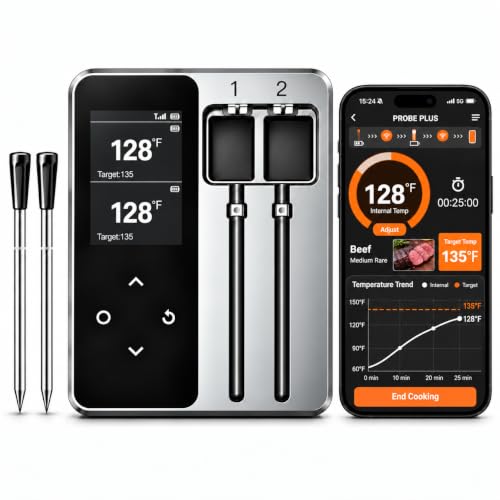
- A leave-in wireless probe with a base unit, so you can track the internal temperature without opening the smoker. Check price on Amazon
- Pink butcher paper for wrapping, which many pitmasters prefer because it lets some smoke through while still speeding the cook. Check price on Amazon
Food safety note: Cook raw brisket to a safe internal temperature and keep cooked meat out of the danger zone between 40°F and 140°F. If you’re cooking for guests with health concerns, or you’re unsure how long cooked brisket can sit, check current USDA guidance or ask a local food safety professional.
Related Questions
Should I smoke brisket fat side up or fat side down?
Most pitmasters place the fat cap up in a offset or pellet smoker so the fat renders slowly over the meat. Heat is usually coming from below, so fat-up protects the flat. Some cooks prefer fat-down in very hot setups, so check your own smoker’s heat source.
Can I speed up brisket by cranking the heat?
You can raise the temperature to 275°F or 300°F, but the cook gets less forgiving. Surface drying and uneven results are more likely. For a first brisket, staying around 225°F to 250°F gives you more control. How to Control and Maintain Your Grill Temperature covers dampers and vents for holding a higher setpoint.
How long can a finished brisket rest before slicing?
Owners often report that a brisket wrapped in a towel and held in a dry cooler stays warm and tender for two to four hours. Slice just before serving, since cut slices dry out quickly. Keep the meat hot throughout the rest, and don’t leave it on the counter.